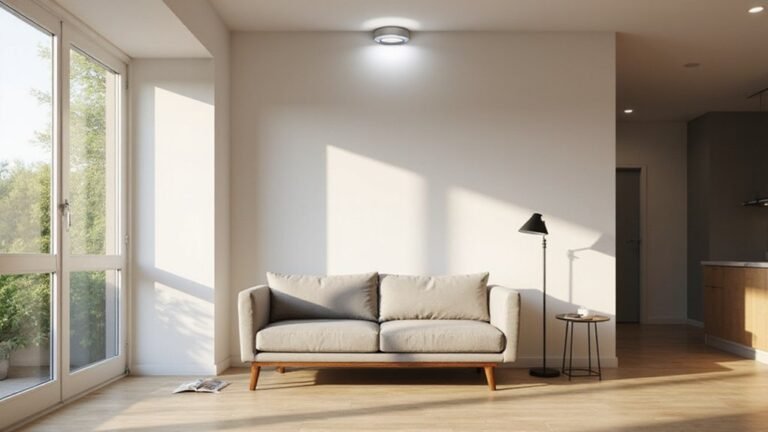

Choosing the right recessed lighting size can make a big difference in how your space looks and feels.
You might wonder if 4-inch or 6-inch fixtures are better for your ceilings and room size.
Generally, smaller ceilings benefit from 4-inch lights for a subtle effect, while taller ceilings often call for 6-inch fixtures to spread light more evenly.
Keep reading to find out which size suits your needs best.
4-Inch vs 6-Inch: Which Fits Your Ceiling Height and Room Size?
Ceiling height is the key factor when choosing between 4-inch and 6-inch recessed lights. For ceilings under 8 feet, 4-inch fixtures feel proportional and unobtrusive, blending well into lower ceilings. With 8-foot ceilings, both sizes are suitable, but in smaller rooms, 4-inch lights tend to work best. When ceilings reach 9 to 10 feet, 6-inch fixtures handle the vertical space more effectively, providing better illumination. Above 10 feet, 6-inch lights shine as primary lighting sources, offering ample coverage and brightness. Choosing the correct ceiling fan direction year-round can also improve energy efficiency in rooms with these fixtures. For a safe installation, always remember to turn off power at the breaker before beginning any electrical work. Using push-in connectors for wiring can simplify the connection process when installing these fixtures.
Room size also influences your choice. Use 4-inch fixtures in bathrooms, hallways, or pantries for a sleek, minimal look. In larger spaces like living rooms or open kitchens, 6-inch fixtures are preferable to ensure broader light distribution. Additionally, 4-inch models often offer flexible color temperature options and energy efficiency, making them a practical choice in smaller or more confined areas where every watt matters.
How to Choose Between Brighter Spread or Tighter Focus
Choosing between a brighter spread or a tighter focus depends on your room’s purpose and your lighting needs. For general illumination in spaces like living rooms or kitchens, opt for wider beam fixtures—around 6 inches in size with at least a 50-degree spread. These fixtures distribute light evenly, minimize hotspots, and allow you to use fewer fixtures overall. This results in a simpler layout and a soft, comfortable light wash that complements any wall color or decor style, though it is best to use a 4000K-5000K color temperature to avoid distorting wall hues. Before installing a wider fixture, ensure recessed light housings can be removed safely to access existing wiring. If your ceiling fan lacks its original control options, you can activate it manually by pulling the fan pull chain directly from the fixture. To ensure a safe removal, always disconnect push wire connectors by pressing firmly on the release mechanism while pulling the wire straight out.
For task-specific areas such as countertops or reading nooks, a tighter focus is best. Narrow beams—typically from 4-inch fixtures—concentrate light precisely where you need it, enhancing visibility and clarity. They also work well for accent lighting, highlighting artwork or architectural details. Keep in mind that these narrower beams require careful fixture placement to avoid creating dark spots. Combining both types in a hybrid setup—wide fixtures for ambient light and narrow fixtures for tasks—provides a balanced, flexible lighting scheme.