Ever wondered how to choose the right chandelier size for your dining room? Getting it just right can really pull a space together.
In this guide, you’ll learn how to determine the perfect diameter based on your room’s dimensions and how to hang the fixture for both style and comfort.
Keep reading for simple steps to find your ideal chandelier size.
What Size Chandelier for Your Dining Room? Start With the Room-Size Rule
Start with the room-size rule to determine your chandelier’s diameter. Add your room’s length and width in feet; the sum gives a good starting point for the fixture’s diameter in inches. For example, a 10-foot by 14-foot room totals 24 inches in diameter. This method isn’t exact but provides a practical guideline many lighting experts trust. It helps ensure the chandelier complements the room’s scale without appearing too small or overwhelming the space. Using this rule is especially useful when your dining table has yet to be chosen. Begin with this baseline and then adjust for ceiling height to achieve a balanced, proportionate look. For heavy chandeliers, a fan-rated brace provides the necessary support for a secure installation. If your ceiling is particularly high, you may need to secure the electrical box with a fan-rated brace to safely support the fixture’s weight. To ensure a clean and safe installation, you must also master the use of wire connectors when connecting the chandelier’s wiring to your home’s electrical system.
How to Size a Chandelier for Your Dining Table Width
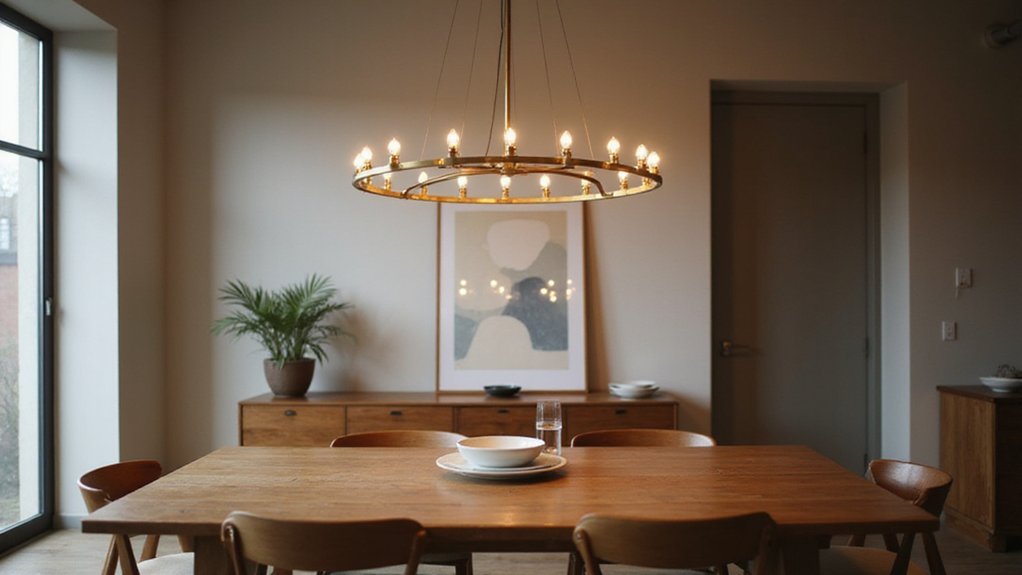
To size your chandelier appropriately for your dining table, aim for a fixture that is between half and two-thirds of the table’s width. For example, a 48-inch-wide table calls for a chandelier between 24 and 36 inches wide, while a 60-inch table needs a fixture measuring 30 to 45 inches. This proportion helps ensure the chandelier complements the table without overpowering the space or feeling too small. When selecting a fixture, consider wall sconce candle holders as an alternative for ambient lighting in adjacent areas.
If you have a rectangular table, match the chandelier’s width to the table’s width rather than the room’s dimensions. For linear fixtures, extend the length to about one-third to one-half of the table’s length. Always subtract around 12 inches from the table width to prevent head bumps when seated. This sizing approach creates a balanced look that aligns with the scale of your table, making the fixture feel integrated without dominating the dining area. Prioritizing the table measurement over the overall room size ensures the fixture fits precisely and looks intentional. Just as choosing the correct ceiling fan direction improves comfort and efficiency in a room, selecting the right chandelier size enhances both the functionality and aesthetic of your dining space. Routine dust accumulation on the blades can be prevented by using the right cleaning tools and methods to maintain your chandelier’s appearance over time.
How High to Hang a Dining Room Chandelier Above the Table
For standard 8-foot ceilings, hang your chandelier 30 to 36 inches above the tabletop. This height ensures it doesn’t obstruct sightlines while providing enough head clearance for seated guests. The goal is to position the fixture high enough to prevent glare at eye level but still maintain a visual connection with the table. As ceiling height increases, adjust the hanging height accordingly—about 3 inches more for each additional foot of height. For a 9-foot ceiling, aim for 33 to 39 inches above the table; for 10-foot ceilings, 36 to 42 inches. It’s best to test the placement at your actual table, as minor adjustments are common to achieve the perfect balance of clearance and proportion. visual connection remains crucial, as hanging the chandelier too high breaks the link between fixture and table, diminishing the overall aesthetic harmony.
Adjust Chandelier Height for High Ceilings and Tall Rooms
For ceilings above 9 feet, adjusting the chandelier height is essential to keep the fixture visually grounded. For each foot of ceiling height, allow 2.5 to 3 inches of chandelier height and adjust the drop accordingly. A good rule of thumb is to choose a chandelier that measures 30 to 36 inches for a 12-foot ceiling, and 50 to 60 inches for a 20-foot ceiling. When installing over a dining table, keep the bottom of the fixture 30 to 36 inches above the tabletop; raise it to 36 to 42 inches in very tall spaces to ensure proper proportion. In open rooms, maintain at least 7 feet of clearance from the floor, increasing to 8 feet when ceilings exceed 12 feet. This approach ensures your chandelier anchors the space instead of floating awkwardly. Understanding the voltage requirements of your lighting setup can help you avoid compatibility issues with dimmers and transformers. Following safe wiring tips from outdoor lighting guides can help you secure the electrical connections during installation. Understanding the cost breakdown between parts and labor helps you plan your budget if you hire an electrician.
How Bright Should Your Dining Room Chandelier Be?
The ideal brightness for your dining room chandelier is between 1,800 and 3,600 lumens for a standard 12 by 15-foot room. This range provides sufficient illumination without overwhelming the space, ensuring your table and surrounding area are well-lit for dining and socializing. For focused task lighting directly over the table, aim for 500 to 800 lumens, which offers bright enough light without creating glare or harsh shadows.
Using a dimmer switch is essential; set it to about 30 to 40 percent during evening meals to protect the bulbs and create a cozy atmosphere. Adjusting the brightness allows you to shift seamlessly from brighter lighting for cleaning or setting the table to softer light for relaxed dining. Stick with warm white bulbs in the range of 2,700K to 3,000K to achieve a flattering, inviting glow that complements your décor. Remember, layering your lighting with sconces or recessed fixtures helps avoid harshness and increases the fixture’s lifespan.
Two Chandeliers Over a Long Table? Here’s How to Make It Work
Two chandeliers work best over a long table when a single fixture cannot adequately cover the entire length. Space each chandelier roughly in the center of each half of the table, ensuring they are evenly spaced from each end — typically between 6 and 12 inches. Leave at least 2 feet of distance between the two fixtures to prevent crowding. Choose smaller chandeliers, about half to two-thirds of the table’s width, to keep the proportions balanced. Hang each chandelier 30 to 34 inches above the tabletop to provide even illumination. This arrangement creates a balanced visual effect, enhances lighting distribution, and can be more cost-effective than a single oversized fixture. Precise spacing and matching sizes are essential; otherwise, the setup may appear unbalanced.
Match the Chandelier Style to Your Room’s Proportions
To match a chandelier’s size to your room’s proportions, start with the length-plus-width rule: add the room’s length and width in feet, and use that sum as the chandelier’s ideal diameter in inches. For example, a room measuring 12 by 14 feet would call for a chandelier around 26 inches in diameter. Larger rooms benefit from a heftier fixture that helps fill the space visually, creating a sense of balance and anchoring the overall design. In contrast, smaller rooms can accommodate a more open and airy chandelier, avoiding any feeling of crowding or overwhelm. Remember that perceived mass matters more than actual weight— a dark, substantial chandelier can anchor a generous dining area, while a lightweight, delicate style complements compact spaces. For ceiling applications, LED strip lights offer a sleek alternative for ambient illumination. For a more cohesive look, consider how the chandelier’s finish interacts with other recessed can lights in the room.
If your ceilings are high, your chandelier should be taller to stay proportional. A good rule is to add 2.5 inches of height for each foot of ceiling height. For instance, if you have 10-foot ceilings, aim for a chandelier around 25 inches tall. This ensures the fixture doesn’t appear as an afterthought or an imbalance, maintaining harmony between the ceiling height and the chandelier’s presence.
Clearance, Sightlines, and Balance Checks Before You Buy
To ensure proper placement, check clearance, sightlines, and balance before making your purchase. For hanging height, aim to position the chandelier 30 to 36 inches above your tabletop. This height prevents glare and promotes even lighting. Walkway safety requires at least 7 feet of floor clearance beneath the fixture to avoid head bumps. To maintain unobstructed sightlines across the table, keep the chandelier hung high enough so it does not block visibility or conversation. The width of the fixture should be about half to three-quarters of your table’s width to achieve visual harmony. Before buying, mock up the fixture’s position in your space, either by taping a length of string or using a quick cardboard cutout, to verify it looks balanced from seated eye level. Finally, measure from the tabletop surface to the ceiling to determine the chain length needed for a perfect fit.
Your Dining Room Chandelier Sizing Formula: A Step-by-Step Guide
To determine the ideal chandelier size for your dining room, start with the room-sum formula: add your room’s length and width in feet, then use that total as the diameter in inches. For example, a 12 by 14-foot room totals 26 inches, giving you a practical minimum diameter for a focal fixture. This ensures the chandelier is proportionate to the space and does not overwhelm or look too tiny.
If your chandelier hangs over a table, switch to the proportion method: the diameter should be about one-half to two-thirds of your table’s width. This creates a balanced, harmonious look between the fixture and the dining surface. For ceiling heights, calculate about 2.5 to 3 inches of fixture height per foot of ceiling to achieve the right scale. Hang the chandelier approximately 30 to 36 inches above the tabletop to maintain proper clearance and visual balance.