Figuring out which light bulb fits your ceiling fan can be confusing, especially with different bases and sizes available. The right choice depends on your fan’s socket type and space constraints, along with your preference for energy efficiency.
Here’s what you need to know to select the perfect bulb that keeps your fan functioning well and looks great.
What Base (E12 or E27) Does Your Ceiling Fan Bulb Need?
The socket base code you need depends on the size of the threaded part of your bulb socket. If the diameter measures about 12 millimeters, you need an E12 candelabra base, which is common in smaller or decorative fans. If the measurement is around 26 to 27 millimeters, then an E26 or E27 medium base is required, the standard size for most modern North American ceiling fans. Always check the printed code on your old bulb or measure the socket’s threaded diameter to determine the correct base. It’s important to match the code exactly because an E12 bulb will not fit into an E26 or E27 socket, and forcing it can damage the fixture. Additionally, verify your fixture’s voltage rating: E26 is suitable for 120 volts, while E27 is used in areas with 220 to 240 volts, though they are often physically interchangeable. Always confirm compatibility before purchasing to ensure safe and proper operation. For safety, never attempt to force an E12 bulb into an E26 socket. When replacing bulbs, it is wise to turn off the power at the circuit breaker before handling any wiring or sockets to prevent electrical shock. If the light still does not work after a bulb change, the pull chain switch may be faulty and require replacement.
What Shape of Ceiling Fan Bulb Fits Your Fixture?
The shape of a ceiling fan bulb that fits best depends on your fixture’s enclosure and style. Compact bulbs like G45, A15, or small globes are ideal for tight spaces where the fixture housing is close to the bulb socket. For open or multi-tulip fixtures, a decorative candle-shaped bulb enhances style, while a small globe provides uniform light diffusion. Before purchasing, measure the available depth and width inside your fan’s glass or shade to ensure the bulb physically fits. Accurate measurements prevent contact with the fixture, avoid forced fitting, and help you select a bulb that maintains the desired aesthetic and light quality. For example, an A15-shaped bulb with an E12 base offers 600 lumens of warm white light while consuming only 6W, making it a durable and efficient choice for ceiling fans. You can also build custom garden lights using similar LED bulbs to create outdoor ambiance with the same energy-saving technology. If you are converting a recessed fixture, always check the safety limits of the converter kit to avoid overheating and fire hazards.
LED vs. Halogen vs. Incandescent: Which Is Best for Ceiling Fans?
LED is the best choice for most ceiling fans. It consumes up to 80% less energy than incandescent bulbs and operates at much cooler temperatures. This cooler operation is especially important in enclosed fixtures, where excess heat can affect the bulb and fixture longevity. LED bulbs also have an impressive lifespan—up to 100,000 hours—meaning fewer replacements over time. Many LED options now support smart technology, allowing you to dim the light or control it remotely. For a stylish alternative, wall-mounted candle holder fixtures are also available to complement your home’s lighting design. If your smart LED bulb stops responding, performing a factory reset can often resolve connectivity issues. For secure installation, always ensure the connection uses the correct wire connectors for your fan’s wiring.
Halogen bulbs provide a warm, familiar glow but run hotter and use more electricity, making them a middle-ground choice. Incandescent bulbs are outdated, wasting most of their energy as heat and lasting only around 1,200 hours. For efficiency, cooler operation, and smart features, LED bulbs are the superior option for ceiling fans.
How Many Lumens Should a Ceiling Fan Bulb Have?
For ceiling fans, aim for 800 to 1,100 lumens per bulb, which is roughly equivalent to a 60- to 75-watt incandescent bulb. For fans with multiple bulbs, assign about 800 lumens per bulb to ensure a strong overall light output. Smaller rooms typically need a total of 700 to 1,000 lumens, while larger spaces benefit from 1,500 to over 3,000 lumens for adequate illumination. Always verify your fan’s maximum wattage rating; LED bulbs producing around 800 lumens at just 8 to 12 watts fit comfortably within these limits. Additionally, consider your color temperature choice to set the desired mood, and opt for dimmable bulbs if you want the flexibility to adjust brightness. Recessed lighting fixtures often require similar lumen planning to avoid dark spots. Compare your bulb’s wattage to the fan’s maximum wattage rating to ensure safe and efficient operation. Pair your chosen lumen output with a compatible bulb base to ensure proper fit and effective lighting. For single-socket fans, select bulbs with well above 1000 lumens to meet the recommended total output. When evaluating brightness, also factor in the arc lamp design to compare how light distribution differs between freestanding and ceiling-mounted fixtures.
What Color Temperature Should You Choose for Your Ceiling Fan?
For most residential spaces, a neutral white color temperature between 3500K and 4100K is ideal. This range provides balanced clarity without the harshness of cooler temperatures, making it suitable for visibility and comfort in kitchens or multi-purpose areas. Task zones like garages or laundry rooms benefit from higher Kelvin values between 5000K and 6500K, which emit a bright, daylight-like light that enhances contrast and energizes the space. However, this cooler light can feel clinical and uninviting in relaxed zones. If you need to replace the fixture, you can safely disconnect push wire connectors to avoid damaging the wiring. Adopting simple habits like cleaning can extend the lifespan of the bulb and fixture. To ensure a secure and code-compliant installation, always turn off power at the breaker before handling any wiring.
Always set the Kelvin level based on the room’s primary purpose. Use lower Kelvin values for warmer, cozier atmospheres, and higher Kelvin for a cooler, more alert environment. Most ceiling fans are compatible with bulbs or integrated LED modules ranging from 3000K to 5000K, giving you practical flexibility to match the lighting to your needs.
Can You Use Dimmable Bulbs in a Ceiling Fan?
Yes, you can use dimmable bulbs in a ceiling fan, but compatibility across the bulb, dimmer or control, and fan wiring is essential. Not all dimmers work with every bulb type, especially LEDs. If your fan has a light kit, you might need an LED-rated dimmer or a specific receiver from the fan manufacturer. Remote or wall controls can also influence whether dimming is possible, as some control systems limit or disable dimming functions.
Avoid using a standard wall dimmer directly on the fan motor, since that’s designed solely for lights. Instead, install a separate dimming circuit for the light kit to ensure proper operation. Always check the bulb’s labeling to confirm it’s labeled as “dimmable” and consult your fan manual for tested bulb and dimmer pairings. Even compatible setups may exhibit occasional flickering or limited dimming range. Incandescent bulbs tend to dim smoothly, but LEDs require matching hardware and careful setup. Before wiring, verify all components are compatible; mismatched hardware can cause buzzing, overheating, or premature failure.
Do Smart Bulbs Work in Ceiling Fans?
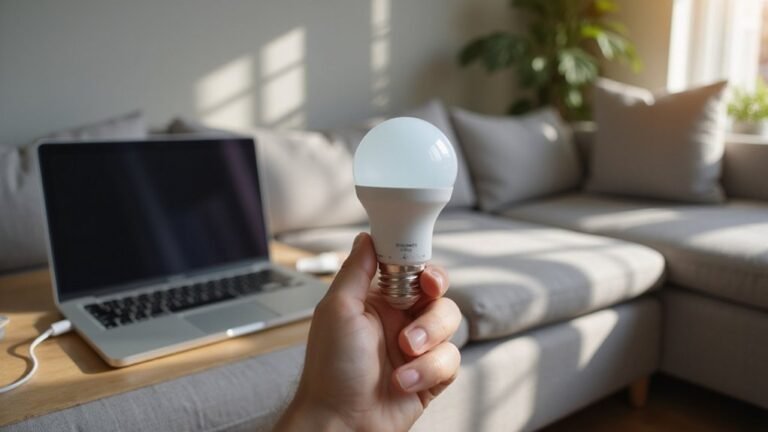
Smart bulbs generally work in ceiling fans when the socket type matches and the bulb fits within the fixture or dome. Common socket types are E26 and E12; confirming compatibility ensures the smart bulb will physically fit and operate correctly. Because fans create constant movement, choose models explicitly rated for ceiling fan use—brands like Govee or Linkind often design bulbs with this in mind. However, you cannot safely use an indoor-rated smart bulb in an outdoor ceiling fan, as it lacks the weather-resistant seals needed to prevent moisture damage. Keep the wall switch on at all times to maintain power; turning it off cuts power and disables your smart features. Avoid using a dimmer switch unless you replace it with a standard on/off switch, as dimmers can interfere with smart bulb operation. Remember, smart bulbs control only the light, not the fan motor. For optimal performance, select bulbs rated for enclosed fixtures and providing around 800 lumens or more to ensure sufficient brightness. For example, the LEDEPLY Zigbee A15 bulbs work well in ceiling fans due to their E12 base compatibility and globe shape. If the fan motor struggles to start or the light flickers, checking the ceiling fan capacitor can help identify power delivery issues. Before installing a new smart bulb, it is helpful to check the light kit for compatibility with the fan’s existing wiring and socket type.
What Happens If Your Ceiling Fan Bulb Is Too Large or Heavy?
Using a bulb that’s too large or heavy for your ceiling fan can cause several issues. First, the extra weight can put stress on the socket and mounting, risking damage to the light kit over time. An oversized bulb may also not fit properly, failing to clear the globe or shroud, which can prevent a secure and safe seal. This poor fit can lead to vibrations, dust accumulation, and potential electrical issues. More importantly, a bulb that exceeds the fixture’s wattage rating can generate excessive heat. When the fixture is enclosed, this heat becomes trapped, raising the risk of damaging the wiring and sockets. Over time, this heat buildup can cause parts to fail or even start a fire. Smart bulbs also communicate wirelessly, but their heavier internal components can add extra strain to a fan’s light kit if not matched correctly. Always ensure that both the physical size and wattage of the bulb match your fan’s specifications to maintain safety and reliable operation. If you are unsure about compatibility, consult a can light conversion guide to explore alternative fixtures. Additionally, a bulb that is too heavy may cause the fan to wobble, leading to noise and premature wear on the fan motor bearings.
Common Mistakes When Buying Ceiling Fan Light Bulbs
Choosing the right bulb for your ceiling fan depends on several careful considerations. First, match the socket base—whether it’s E12 candelabra or E26 medium—to ensure the bulb fits securely. Using the wrong base can lead to frequent socket damage or the bulb not fitting at all. Always check the fixture’s label for maximum wattage and do not exceed it; surpassing this limit increases the risk of overheating and fire hazards.
Brightness is measured in lumens, not watts, so select bulbs that provide the desired light output for your space. For bedrooms, aim for a total lumen range between 1,000 and 2,000, especially if your fan has multiple bulbs. If your fan includes a dimmer switch, only install dimmable bulbs to prevent flickering or buzzing issues.
Energy efficiency also matters. LED bulbs use fewer watts to produce the same brightness as incandescent or halogen bulbs, saving you money and reducing heat. Regarding color temperature, around 3000K gives a warm white glow ideal for cozy settings. Lastly, confirm that the bulb shape and size fit comfortably inside the fan’s globe—vintage or larger shapes might not fit in smaller fixtures, so measure carefully before purchasing.