
Choosing the right batteries for your string lights can make a big difference in how long they shine and how easy they are to maintain. Whether you opt for alkaline AAs for a bright, initial glow or rechargeable NiMH batteries for longer, more consistent performance, understanding your options helps you get the most out of your setup.
From runtime expectations to bulb styles and outdoor ratings, this guide will show you everything you need to create a reliable, beautiful lighting display.
AA vs. Rechargeable: Best Battery for Outdoor String Lights
Rechargeable NiMH AA batteries are generally better for outdoor string lights over time because they save money and create less waste. The main difference between alkaline and NiMH cells lies in their chemistry and voltage. Alkaline AAs provide about 1.5 volts when fresh, while NiMH cells offer around 1.2 volts nominally. For a set of three, that adds up to 4.5 volts with alkalines versus 3.6 volts with NiMHs. Although the lower voltage may make the lights appear slightly dimmer initially, NiMH batteries have a flatter voltage curve, which helps maintain consistent brightness throughout their run. Alkaline batteries tend to start brighter but fade faster, especially with repeated outdoor use. Choosing rechargeables can significantly reduce long-term costs and waste, even if it means accepting a bit less initial brightness. For those concerned about efficiency, smart plugs can further optimize energy use by automatically turning off the lights when not needed. A ceiling fan uses a similar seasonal approach to optimize energy, with its direction setting reversed for summer versus winter to improve air circulation and comfort. Just as with LED downlights, it is important to verify that the light bulbs in your string lights are dimmable before connecting them to a dimmer.
How Long Do Battery String Lights Really Last?
Battery-powered string lights typically last between 18 and 24 hours on standard AA batteries. Incandescent sets tend to run only 3 to 7 hours, making them less suitable for prolonged use. Microdrop LED lights with thin wire can shine for over 100 hours, offering significantly longer illumination.
The type of battery you use greatly affects runtime. Fresh alkaline AA batteries usually support 20 to 70 hours of continuous lighting, depending on power consumption. Lithium AA batteries can extend that to 80 to 200 hours, thanks to their higher energy density. However, real-world performance often falls short of manufacturer claims because high brightness settings and continuous operation drain power faster. For instance, a string of 50 LEDs on alkalines might last between 48 and 100 hours, but cheaper models may start dimming after just 20 hours. Small fairy lights powered by CR2032 coin cells often run for about 72 to 96 hours. To mimic the long-lasting performance of LED microdrops, ensure your light string’s wiring and battery contacts are clean and secure, as unbalanced components can cause power loss and reduced runtime, just as blade imbalance hampers fan efficiency. Selecting proper mounting hardware for your string lights can improve both stability and battery life, similar to how choosing a flush mount ceiling fan optimizes performance in low-ceiling rooms.
Timers and Lighting Modes That Save Battery Life
Enabling the memory function ensures your preferred mode is saved after replacing the batteries. This feature means you won’t have to reset your settings each time the power is interrupted. To maximize battery life, choose a timer that limits how long the device stays active and opt for effects known for low energy consumption. Combining these strategies helps you get the most out of each charge, keeping your device running efficiently over time. The product’s repeating daily timer (6 hours on, 18 hours off) automatically saves battery by limiting active duration. For consistent coverage, follow placement rules that maintain even spacing between fixtures to avoid dark spots. Understanding the safe wiring tips for hardwired fixtures ensures you avoid electrical hazards when installing permanent lighting. Just as you adjust the airflow direction seasonally, you can also change the mode to a lower-energy setting during cooler months to further reduce power draw.
Indoor vs. Outdoor Bulb Styles: Edison, Globe, or Fairy?
Edison bulbs are best suited for outdoor settings like patios or pergolas, where their vintage design and warm amber glow create a dramatic, atmosphere. Globe bulbs are a safer choice for dining or entertaining spaces because they emit soft, diffused light that remains clear from a distance, making them ideal for general illumination. Fairy lights work well indoors, such as in bedrooms or around accent walls, offering a subtle, decorative glow on thin, flexible wires that can be twisted around fixtures or furniture. However, Edison bulbs are not suitable for task lighting, as their purpose is to enhance ambiance rather than provide bright, focused illumination. For comparable flexibility in positioning light exactly where needed, a swing arm floor lamp offers similar adjustability for focused indoor use. Match your bulb choice to your space’s scale and function to achieve the desired visual effect. For better longevity, consider LED string lights which use less energy than traditional incandescent options. For spaces needing both airflow and accent lighting, a ceiling fan with chandelier combines illumination with stylish comfort.
What IP Rating Do Outdoor String Lights Need?
Outdoor string lights should have an IP65 rating or higher. The IP rating indicates how well the lights protect against dust and water, with the first digit representing solid particle protection and the second digit representing water resistance. For outdoor use, especially in exposed areas like open patios or pergolas, IP65 is recommended because it is dust-tight and can withstand low-pressure water jets, such as rain or sprinkler splashes. When planning your installation, always ensure you turn off the power at the breaker before handling any electrical wiring connections to prevent shock.
If you’re hanging lights under covered areas like porches or eaves, a minimum of IP44 is sufficient, as it handles splashes and light rain. However, for open, unprotected spaces where weather exposure is more intense, higher ratings like IP65 or even IP67 are safer choices. IP67 offers even greater water resistance, making it suitable for situations where the lights might be submerged temporarily, such as near pools or puddles. Always check the second digit of the IP rating because it indicates protection against water—the critical factor for outdoor conditions.
How Many Feet and Bulbs Do You Need for Your Space?
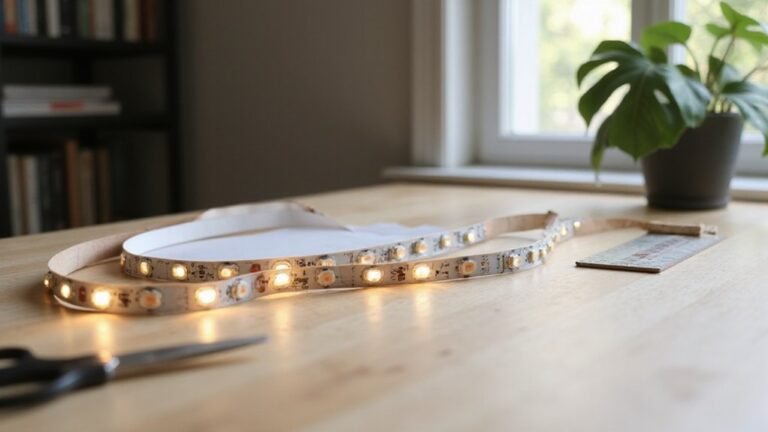
To cover your space effectively, you’ll need to determine the appropriate footage and bulb spacing. For a rectangular patio measuring 20×12 feet, a perimeter layout with a gentle café drape requires approximately 74 feet of string lights. If you choose to light only two opposite sides, that drops to around 46 feet. Use layout multipliers to estimate needed footage: perimeter layouts are multiplied by 1.0, zigzag or zigzag layouts by 1.5, and crisscross or lattice layouts by 2.0. For a medium-sized patio measuring 12×16 feet, plan for 60 to 80 feet of string lights, which typically translates to 2 or 3 strands.
For bulb spacing, aim for 2 to 3 feet between bulbs for even, balanced brightness. Tighter spacing—about 1 to 2 feet—is better for creating a cozy, intimate atmosphere. Don’t forget to add 2 to 6 feet of slack for wrapping around posts or other fixtures. When choosing bulbs, consider warm white for a classic, inviting glow or RGB options if you want vibrant colors for parties. Always secure your lights with clips or hooks to prevent sagging or damage, especially if you plan to hang them for an extended period. For a clean DIY finish, use 4 way wire connectors to safely join multiple strands and simplify your wiring setup.