
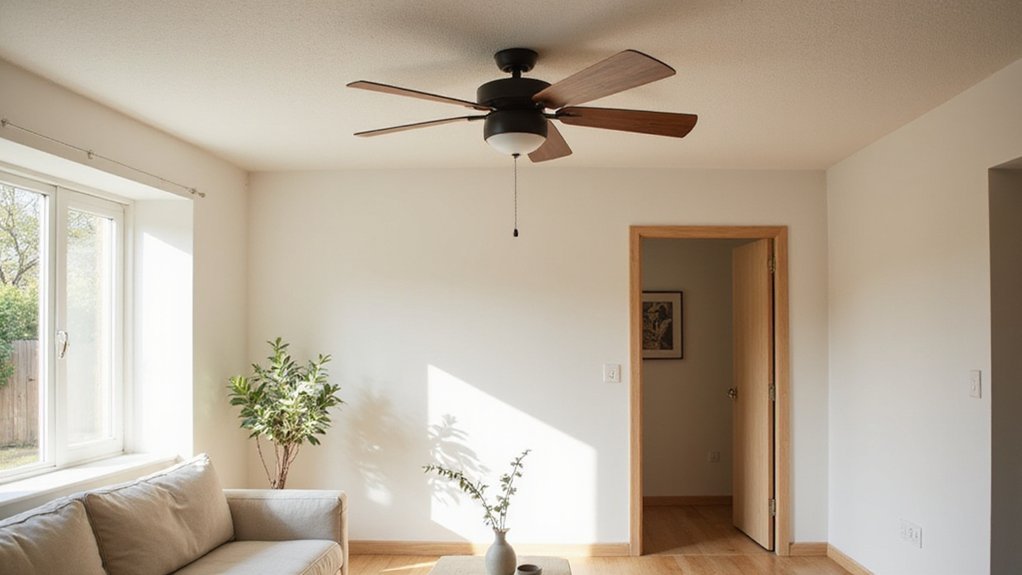
Struggling to find a ceiling fan that fits your low-ceiling space? A low profile ceiling fan is designed to mount flush against the ceiling, saving space and maximizing headroom.
These fans are perfect for rooms where standard fans might be too tall or unsafe.
Below, you’ll find everything you need to know to pick the right fan for your needs.
Why Low Ceilings Need a Different Kind of Fan
Low ceilings, typically between seven and eight feet high, require a specific type of fan. A flush-mount fan installed directly against the ceiling keeps headroom clear and maintains safety by keeping blades at a safe distance from people and objects. These fans are now available in various decorative styles, from modern to rustic, allowing you to find a design that complements your room’s aesthetic. Beyond their style, many of these fans also offer integrated LED lighting to further save space and reduce the need for additional fixtures. Before installing a new fan, it is important to safely remove recessed light covers from the ceiling to access the wiring and mounting hardware. Besides their style, they also improve energy efficiency by circulating air effectively. This creates a wind-chill effect that makes you feel cooler without lowering your thermostat. As a result, you rely less on air conditioning, which helps save money throughout the year. This principle is similar to how low profile recessed can lights maximize clearance while still providing effective illumination in tight spaces. By enhancing airflow in compact spaces, low-profile fans help you stay comfortable while using less energy.
Low Profile vs. Standard Ceiling Fans
Low-profile fans mount flush against the ceiling, making them ideal for rooms under 8 feet in height. This design creates a sleek, streamlined appearance while conserving headroom. However, because the blades sit closer to the ceiling’s boundary layer, you might experience about 15–20% less airflow efficiency compared to standard fans. To maximize comfort, you should adjust the ceiling fan direction seasonally to improve air circulation. Standard ceiling fans hang from a downrod, positioning the blades further from the ceiling. This allows the blades to operate in cleaner, less turbulent air, resulting in better circulation and higher energy efficiency. The downrod also adds visual interest and is well-suited for taller spaces, typically over 8 feet. For a safe DIY finish, always follow proper wiring precautions when installing either fan type. Before swapping out an old unit, remove ceiling fan blades carefully to avoid damaging the mounting hardware.
When choosing between the two, consider your ceiling height and room size. Low-profile fans suit tighter spaces with limited headroom, while standard fans provide stronger airflow performance in larger, higher-ceiling rooms. Be sure, however, that blades on standard fans remain at least 7 feet from the floor for safety and comfort.
Are Low Profile Fans as Good at Moving Air?
Yes, low-profile fans can move air effectively, often comparable to standard ceiling fans. While they typically have smaller diameters—usually around 24 to 36 inches—they can still deliver solid airflow when equipped with quality blades and modern motors. Look for units with blade pitches around 12 to 14 degrees, combined with airfoil shapes designed to reduce turbulence and maximize efficiency. A high-quality low-profile fan with a contemporary DC motor can easily produce 3,000 to 4,000 CFM, enough to circulate air comfortably in smaller rooms or spaces with limited headroom. Some premium flush-mount models can approach or exceed 4,500 CFM. So, while they may not match the raw power of larger downrod fans, a well-built low-profile fan offers effective airflow with the benefit of saving space and maintaining a sleek appearance. For safe installation, always follow proper wiring techniques to ensure the fan and light operate correctly without electrical hazards. Securing each connection with a clean twist prevents loose wires and reduces the risk of arcing or shorts. Just as with LED downlights, maintaining consistent use and avoiding excessive heat buildup extends the overall lifespan of the fan’s internal components.
How to Measure Your Room for a Flush-Mount Fan
To measure your room for a flush-mount fan, start by determining the length and width of the space. Multiply these two measurements to get the square footage. For an L-shaped room, divide it into two rectangles, measure each separately, and then add their areas together. Rooms up to 75 square feet are best suited for fans with blades 29 to 36 inches in diameter, while larger spaces of 144 to 225 square feet benefit from 44-inch fans. When wiring your fan, ensure you secure connections with proper wire connectors to prevent electrical hazards. Understanding recessed can lighting costs can help you compare the expense of installing dedicated ceiling support for a fan versus using an existing junction box.
Next, check your ceiling height. If the ceiling is between 7 and 8 feet high, a flush-mount fan is ideal because it requires only about 6 to 10 inches of clearance from the blades to the ceiling. Make sure the blades are at least 18 inches away from walls or other obstructions and consider wall-mounted or corner-mounted fans if ceiling clearance is limited. Always measure to verify that the blades will sit at or above 7 feet from the floor for safety. To determine the fan diameter, measure from tip to tip for even blade counts or from blade tip to center and multiply by two for fans with an odd number of blades. Confirm that beams or furniture do not block airflow to ensure optimal circulation.
What to Look for When Buying a Hugger or Close-Mount Fan?
When shopping for a hugger or close-mount fan, your ceiling height is crucial. These fans are best suited for ceilings 8 feet or lower, and they are designed to sit close to the ceiling from a maximum of 9 feet. To ensure safety, blades should be at least 7 feet above the floor. For low ceilings, low-profile fans are the recommended choice to maintain proper clearance. Before starting any installation, you should also turn off the power at the breaker to avoid electrical shock.
Match the blade span to your room size: 42 to 44 inches is suitable for spaces between 144 and 225 square feet, while a 52-inch fan works well for rooms up to 400 square feet. Prioritize fans with a high airflow rating, or CFM (cubic feet per minute), ideally over 6,000. ENERGY STAR certification indicates greater energy efficiency, especially with DC motors, which tend to run quieter and consume less electricity than traditional AC motors. Just as smart plugs vary in running cost and lifespan, choosing a fan motor type also impacts long-term energy savings.
Pay attention to noise ratings, especially if you plan to install the fan in a bedroom. Reversible blades allow year-round use by providing both cooling and heating circulation options. Lastly, consider the fan’s finish—options range from matte black to brushed nickel—so you can match your decor. Confirm whether the fan has damp or wet ratings if you plan to mount it in bathrooms, porches, or other moisture-prone areas.