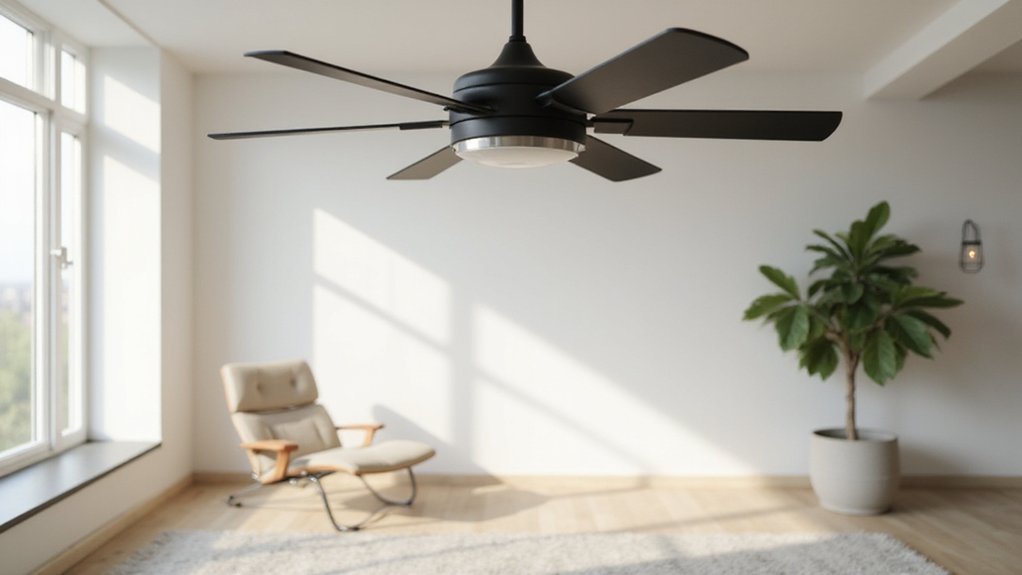
Many people wonder whether to choose a traditional AC ceiling fan or a more efficient DC model.
Generally, DC fans are more energy-efficient, quieter, and offer more speeds, but they cost more upfront.
Understanding the trade-offs can help you pick the best fan for your comfort and budget.
The details are right below.
How Much Do DC Ceiling Fans Really Save on Your Electric Bill?
Replacing an AC ceiling fan with a DC model can significantly cut your energy bill. DC fans typically consume between 15 and 35 watts, compared to 60 to 90 watts for traditional AC fans. This difference means you use roughly 60 to 70 percent less energy per fan. Running one fan for eight hours daily during the cooling season can save you about $12 to $18 annually, based on average U.S. electricity rates. If you have four fans, those savings increase to $48 to $72 each year. Over their lifespan, this totals approximately $720 to $1,440 saved. Additionally, DC fans operate more quietly, especially at lower speeds, and energy efficiency improves when you keep the fan speeds moderate since wattage increases at higher settings. Keep in mind that your actual savings depend on your local electricity rates, how often you run the fans, and the specific model you choose. For year-round use, choosing the right ceiling fan direction can further optimize comfort and efficiency. Before installing a new DC fan, you should first check the power source to ensure it is turned off at the breaker, much like the preparatory steps recommended when changing under cabinet light bulbs. To avoid electrical hazards during installation, always use a dedicated circuit for the fan wiring, just as you would when securing a connection for a smart bulb.
The Final Trade-Off: Upfront Cost vs. Long-Term Savings and Quiet
The higher upfront cost of a DC fan is often justified by its energy savings and quiet operation, especially in spaces you use daily. If you run the fan for several hours each day, the savings on electricity bills can offset the initial investment within two to five years. This makes the DC model more economical over the long term, particularly for bedrooms, nurseries, or media rooms where quiet performance is a priority. However, for spaces used infrequently like a garage or guest room, the lower operating costs may never outweigh the higher purchase price. In these cases, a cheaper AC fan might be more suitable despite its louder noise and less efficient energy use. For example, when considering under cabinet light placement, similar trade-offs between upfront cost and long-term savings apply depending on the room’s usage. When selecting any electrical fixture, proper installation begins with a secure ceiling fan brace to prevent wobbling or failure. Choosing the right wire connector types can also ensure safe and reliable connections. Ultimately, your decision hinges on your usage habits and whether you prioritize lower long-term costs and quieter operation over upfront savings.
How Much More Do DC Ceiling Fans Cost Upfront?
Because DC ceiling fans use more advanced electronics and motor designs, you’ll typically pay a $50–$200 premium per fan compared to a comparable AC model. Basic AC fans usually range from $50 to $150, while DC models start around $100 to $300. High-end smart DC fans can reach up to $999. The higher upfront cost reflects the expense of precision components, not just brand markup. This premium often translates into better energy efficiency and quieter operation, as DC motors produce less electrical noise than AC units. However, you won’t see an immediate financial return on this extra expense. For budget-conscious shoppers, AC fans are generally more affordable initially. But if energy savings and near-silent airflow are priorities, the higher initial investment might be worthwhile.
How Long to Recoup a DC Ceiling Fan’s Cost?
The payback period for a DC ceiling fan typically falls under three years for fans running nightly. This duration depends mainly on the price premium, which is usually between $20 and $50 more than an equivalent AC fan, and your expected monthly savings on energy costs. To estimate your own timeline, divide the extra cost by your monthly savings. For example, if your fan costs $40 more and saves you $10 each month, you’ll recoup your investment in four months. If your local electricity rates are high, the savings—and therefore the payback period—speed up; lower rates lengthen the time needed. To safely install your chosen fan, follow a step-by-step method that prioritizes proper electrical connections, similar to the process of making secure wire splices for reliable performance.
When AC Ceiling Fans Still Make Sense for Your Budget
For occasional-use rooms like guest bedrooms, AC ceiling fans still make sense financially. Since you’ll only run the fan a few times each year, the higher initial cost of a DC fan isn’t justified by its operational savings. Basic cooling needs don’t require advanced features or maximum efficiency, so a reliable AC fan provides sufficient airflow at a lower upfront price. For a comparable approach to cost-effective lighting, recessed can lights offer practical guidance for selecting budget-friendly fixtures.
Noise levels also matter. If the fan operates in a low-traffic area where a slight hum isn’t disruptive, an AC fan’s noise profile usually won’t be an issue. For rental or investment properties, keeping installation costs low is more important, making AC fans the practical choice. With moderate energy use, your ceiling fan might cost less than a dollar per month to run, so the savings are minimal and may not outweigh the lower upfront cost of an AC fan. Selecting fixtures based on energy efficiency ratings can help you compare long-term operating costs without sacrificing upfront affordability. For a similar upgrade in control and efficiency, pairing an AC fan with a smart light switch can provide remote operation without replacing the entire fixture.
Are DC Ceiling Fans Quieter Than AC Fans for Bedrooms?
DC ceiling fans are generally quieter than AC models when used in bedrooms. The main reason is their brushless motor design, which reduces friction and vibration. This results in less humming and buzzing sounds, creating a quieter environment for sleep. Because of this, DC fans are often preferred in quiet spaces like bedrooms. They also tend to be more energy-efficient, using less power while maintaining smooth and quiet operation at typical sleeping speeds. However, the quality of the build still matters—poorly made DC fans can be noisier than high-quality AC fans. A key safety step when installing any ceiling fan is to secure the wiring with wire nuts to prevent loose connections. For instance, when selecting a fixture for a tranquil outdoor setting, best outdoor pendant lights offer similar peace and efficiency. Using a remote control to adjust your ceiling fan speed and lighting can also enhance convenience, much like how a programmable remote simplifies managing an LED strip setup. Overall, for a peaceful sleeping environment, a well-made DC ceiling fan usually offers the quietness you want.
How Speed Settings Change the Comfort of AC vs DC Fans
DC fans provide typically 5 to 12 speed options, giving you much finer control over airflow compared to the 3 speed settings usually available in AC fans. This range allows you to precisely adjust the fan’s speed to match your comfort needs—whether you want a gentle breeze while sleeping or a stronger airflow during peak heat. With more steps, you can avoid the discomfort of sudden shifts between too weak or too strong settings, creating a more consistent and tailored environment. The smooth, low-speed circulation also means you won’t experience occasional overcooling or needing to frequently change settings as conditions change throughout the day. Overall, the greater number of speed options in DC fans lets you fine-tune airflow for maximum comfort. This precise control is enabled by advanced motor technology that reduces electrical resistance with opposing polarity magnets. Similarly, just as wall sconce candle holders offer adjustable ambient lighting for different moods, DC fans offer variable speeds to match changing environmental needs.
Which Control Options Work Best: Wall, Remote, or App?
Wall control is the most compatible choice for AC fans. It is integrated into the wall wiring, offers straightforward three-speed options, and makes replacing existing wired setups simple. Keep in mind that AC and DC controllers are not interchangeable; using the wrong type can cause performance issues or damage. If you prefer a direct, reliable connection that doesn’t require additional devices, wall control is your best bet. For a kitchen renovation, track lighting options offer similar flexibility in layout and brightness.
Remote controls are ideal for DC fans, which typically come with remote operation by default. They provide access to multiple speeds—often more than six—and are easy to install without rewiring. With a remote, you can adjust the fan settings from anywhere in the room, making it convenient for daily use.
App controls shine when you want smart features like timers, sleep modes, or seasonal toggles. They often connect via Wi-Fi or Bluetooth, offering precise control and scheduling options. Apps allow for more advanced customization but may require initial setup and ongoing updates. If you want a blend of convenience and advanced features, apps are the top choice, especially for DC fans with smart home compatibility. Using the wrong controller can lead to performance issues similar to mismatched LED light components.
Do Slimmer DC Ceiling Fan Motors Make Installation Easier?
Slimmer DC ceiling fan motors can make installation somewhat easier by reducing the weight you need to handle overhead. However, they do not eliminate the main tasks involved, such as mounting, wiring, and balancing the fan. The lighter motor helps you position the fan onto the mounting bracket more easily, but it doesn’t change the overall complexity of the process. You still need to lift and secure the entire assembly onto a ceiling box rated for at least 90 pounds and run wires through tight spaces. Many DC fans come pre-wired, which simplifies the connection process, but wiring must still be handled carefully since DC motors are more sensitive to wiring issues. This sensitivity echoes the careful pairing steps required for smart home devices, which must be followed precisely to avoid connectivity failures. Tasks like attaching blades, ensuring proper clearance, and adjusting the canopy remain the same. So, while the slim profile of the motor reduces some overhead effort, the overall installation steps stay largely unchanged. Additionally, the lighter weight compared to traditional AC motors is facilitated by the quiet DC motors requiring less electricity and eliminating humming noise, though this does not reduce the need to properly handle wiring due to their sensitivity. A similar approach to the low profile housings used in recessed lighting can help maximize overhead space during fan installation.